
Bellevue, WA · King County
Water Heater, AC and Appliance Leak Damage
A water heater that let go in the attic, an AC unit dripping through the ceiling, or a washer hose that split? Call (425) 307-0286 to reach a local restoration company that dries what got wet and documents it for your insurance. A licensed plumber or HVAC technician fixes the unit itself.
Call (425) 307-0286.
What is a water heater or AC leak?
A water heater leak comes from the tank, its fittings or its valves. An AC leak comes from the condensate drain line or the drain pan that catches the water the unit pulls out of the air. Appliance leaks come from supply lines and hoses under constant water pressure.
Each of these can drip for days before anyone notices, so the water often reaches the ceiling or the floor below before the leak is found.
Water heater leaking? Do this first
- Shut off the water to the tank. Close the cold-water valve on the pipe at the top of the heater. If you can’t find it or it won’t turn, close your home’s main shutoff.
- Turn off the energy. For a gas heater, turn the gas valve on the unit to “off.” For an electric heater, switch off its breaker. Smell gas? Leave the house and call 911 from outside.
- Watch out for hot water. Water from a failed tank can be scalding. Don’t reach into a pan of hot water.
- Take photos. Get the heater, the label with its age, the wet floor and any ceiling stains below.
- Call (425) 307-0286. Tell the company where the heater sits (attic, garage or closet) and which rooms are wet.
Why water heaters fail
Most tank water heaters last about 10 to 15 years, and tankless units about 20 (U.S. Department of Energy).
Water quality plays a part too. Hard water leaves mineral scale inside the tank over time. Ask your plumber whether flushing the tank or checking its anode rod makes sense for your heater.
When the heater is in the attic or garage
A heater in the attic leaks straight down into the ceiling and the rooms below. A heater in a garage closet can soak the drywall, baseboards and the next room over. Either way, the water spreads farther than it looks.
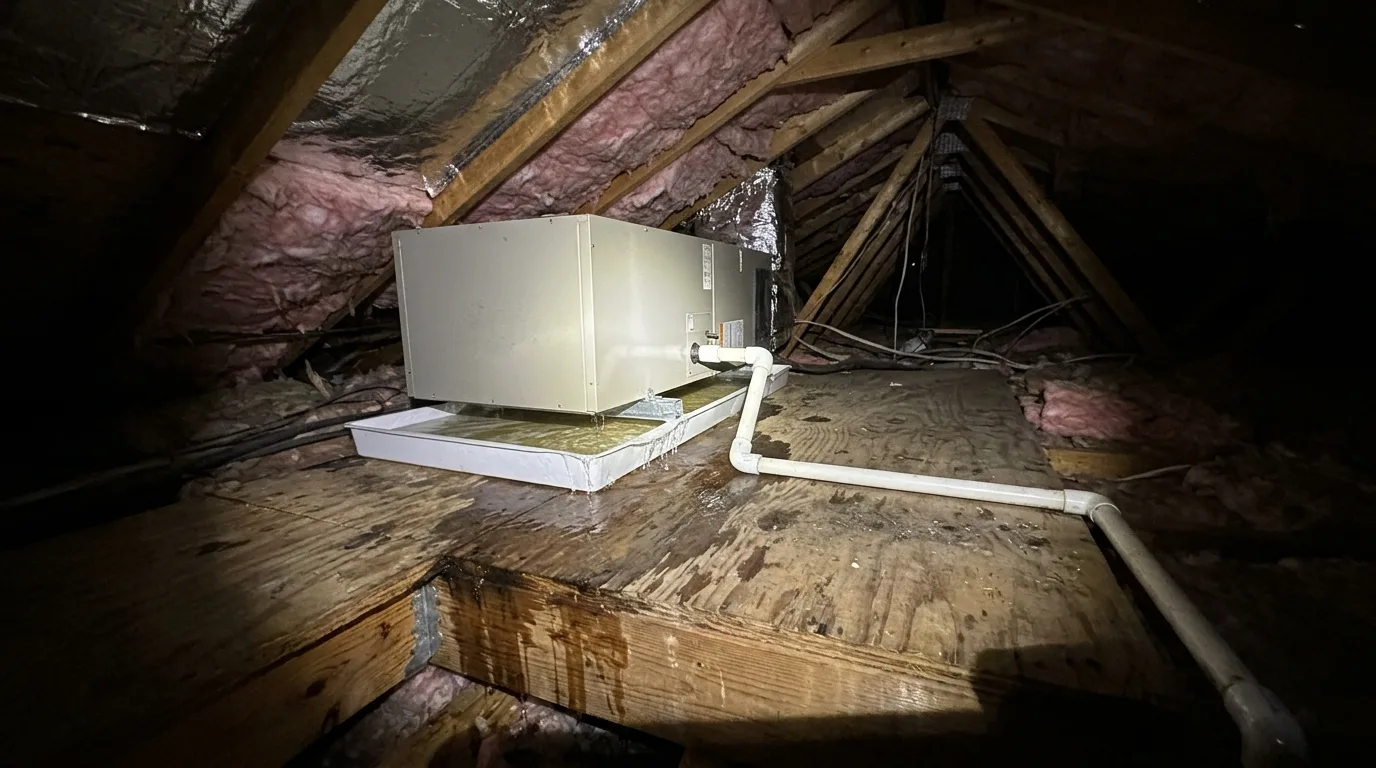
Check the drain pan under an attic heater now and then, and make sure its drain line isn’t blocked. A pan can’t help if its drain goes nowhere.
Repair or replace?
A plumber can tell you whether the leak is at a fitting or valve, or from the tank itself. A leaking fitting can often be fixed. A leaking tank usually means replacement.
Got a 16-year-old heater that still works? It’s already past the typical tank life. Replacing it on your schedule beats finding it in a pool of water. Bellevue requires a permit for water heater replacement (City of Bellevue Building Inspections).
Bellevue’s Housing Rehabilitation Program lists water heaters among its emergency repairs.
AC leaking water into the house?
The most common cause of an indoor AC leak is a clogged condensate drain line, which makes the drain pan overflow (PickHVAC). Turn the AC off at the thermostat, then at its breaker, to stop more water.
Your AC pulls water out of the air as it cools. That water drips into a pan and runs out through a small drain line. When algae or dirt clogs the line, the pan fills and spills. With an air handler in the attic, the water lands on the ceiling insulation and drywall below.
AC drain leaks are worst in summer.
Some systems have a float switch, a small safety switch that shuts the AC off when the pan fills. If your AC stopped cooling and the pan is full, the switch may have done its job. Don’t bypass it. Clearing the line with a wet/dry vac often helps (Direct Energy). An HVAC technician should find out why it clogged.
AC leaks often drip for days before anyone notices. If you see a stain on the ceiling under the air handler, call (425) 307-0286 for a moisture check.
Washer hoses, dishwashers and ice makers
Appliance supply lines are small, but they’re under constant water pressure. When one fails, it can run until someone shuts it off.
- Washing machine hoses: most manufacturers recommend replacing them every 3 to 5 years (HomeServe). Braided steel hoses wear out too. A failed hose in an upstairs laundry room comes through the ceiling below.
- Dishwashers: leaks often start at the supply line or drain hose under the cabinet. The first sign can be swollen flooring or a soft spot at the toe kick.
- Ice makers and refrigerators: water on the floor by the fridge can come from the ice maker supply line. Turn off the valve behind the fridge or under the sink.
Water from a washer or dishwasher overflow counts as Category 2 (gray) water under the IICRC S500 standard. It needs cleaning, not just drying.
A leak sensor near the water heater, washer and fridge warns you early. A smart shutoff valve on the main line can close the water by itself. Many insurers offer a premium discount for one (Roger Wakefield, 2026), so ask your agent.
Water coming through the ceiling? Stay safe first
A sagging or bulging ceiling can be holding a lot of water, and it can come down without warning. Keep everyone out from under it. If water is near a light fixture, fan or outlet, turn off the breaker for that room. Our ceiling water damage guide covers the warning signs, upstairs bathroom leaks and what gets dried or replaced.
Ceiling sagging or dripping right now? Shut off the water, clear the room, then call (425) 307-0286.
Will insurance cover a water heater or AC leak?
Usually the water damage is covered if it was sudden and accidental, but the broken appliance itself usually isn’t.
A water heater that bursts falls in the same group. A heater that dripped into its pan for months may be called wear and tear. So may an AC drain that leaked slowly into the ceiling.
What helps your claim:
- Photos. Photos and the failed part from the day you found the leak.
- Technician report. The plumber’s or HVAC technician’s report saying what failed.
- Readings. Moisture readings and dated photos showing how far the water spread.
Your adjuster decides what’s covered. The restoration company should document the damage and work with your adjuster. How the costs break down: water damage restoration cost.
Who fixes the unit, and who dries the house?
A licensed plumber fixes or replaces the water heater and the supply lines. An HVAC technician fixes the AC drain and pan. The restoration company handles the water damage: extraction, drying, the moisture readings and the records.
Ask the plumber for a license number. Who does the work and how to check them: about us.
What raises and lowers the leak risk above a ceiling?
A water heater or AC unit above a ceiling raises the leak risk. A drain pan, a clear drain line and a leak sensor lower it.
Close the water valves to the unit, turn off its gas or power, and put a bucket under any drip. Check the ceiling below for stains. If anything is wet, call (425) 307-0286.
A small drip caught right away may dry with a fan. Water that soaked into ceiling drywall or insulation needs readings to confirm it’s dry. The EPA advises drying wet materials within 24 to 48 hours to prevent mold growth. See water extraction and drying.
Frequently asked questions
Where do water heaters and AC units usually leak from?
Most leaks start at the tank or its fittings, or at the AC condensate drain line and drain pan. A drain pan, a clear drain line and a leak sensor help catch it early.
What should I shut off first when a water heater or AC leaks?
Close the water valve to the unit, then turn off its gas or power. For an AC leak, turn the AC off at the thermostat, then at its breaker, to stop more water. Put a bucket under any drip and call (425) 307-0286.
Do I need a permit to replace a water heater?
Yes. Bellevue requires a permit for water heater replacement (City of Bellevue Building Inspections).
Will insurance pay for the water heater or AC unit itself?
Usually the water damage is covered if it was sudden and accidental, but the broken appliance itself usually isn’t.
How long do water heaters last?
Most tank water heaters last about 10 to 15 years, and tankless units about 20 (U.S. Department of Energy). A heater past that age is already near the end of its typical life, so replacing it on your schedule beats finding it in a pool of water.
How quickly should wet materials be dried?
The EPA advises drying wet materials within 24 to 48 hours to prevent mold growth. A small drip caught right away may dry with a fan, but water that soaked into ceiling drywall or insulation needs readings to confirm it’s dry. See water extraction and drying.
Leak from a water heater or AC? Call (425) 307-0286
Shut off the water and power to the unit, take photos, then call.