
Bellevue, WA · King County
Water Damage Repair and Rebuild
The fans are gone and the readings say the house is dry. Now there are holes in the drywall, baseboards in the garage and maybe no floor in one room. Water damage repair is the rebuild that puts those back. Call (425) 307-0286 to reach a local restoration company, and ask whether it does the rebuild too.
Call (425) 307-0286.
Do I need water damage repair, or was drying enough?
If anything was cut out or pulled up during drying, you need repairs. If everything dried in place, you may only need touch-up paint.
Drying and repair are two separate jobs. Drying, also called mitigation, removes the water and anything that can’t be saved. Repair, also called reconstruction, puts the home back to how it was before the leak. The industry calls that the pre-loss condition.
Not every restoration company does rebuild work. Some only dry, and others do both. Ask on the first call which services the company offers.
Still have water on the floor? Start with emergency water extraction and drying. Repairs come after the house is dry.
What happens to wet drywall?
Wet drywall can often dry in place if it isn’t swollen and the seams are still tight. If it’s swollen or the seams have split, the EPA says to remove it and replace it (EPA mold remediation guide, Table 1). Drywall that feels soft is usually treated the same way.
Drywall soaks up water like a sponge. Water climbs up from a wet floor into the bottom of the wall. That’s called wicking. It’s why the wet area is often higher than the puddle was.
The type of water matters too. Drywall soaked by clean water from a supply line can often be saved. Drywall soaked by dirty water or sewage is usually cut out. Our guide to water damage categories and classes explains the difference.
Can water-damaged drywall be repaired, or does it have to be replaced?
Both happen. A small damaged spot can be cut out and patched. A wall with a long wet section usually gets a strip of new drywall.
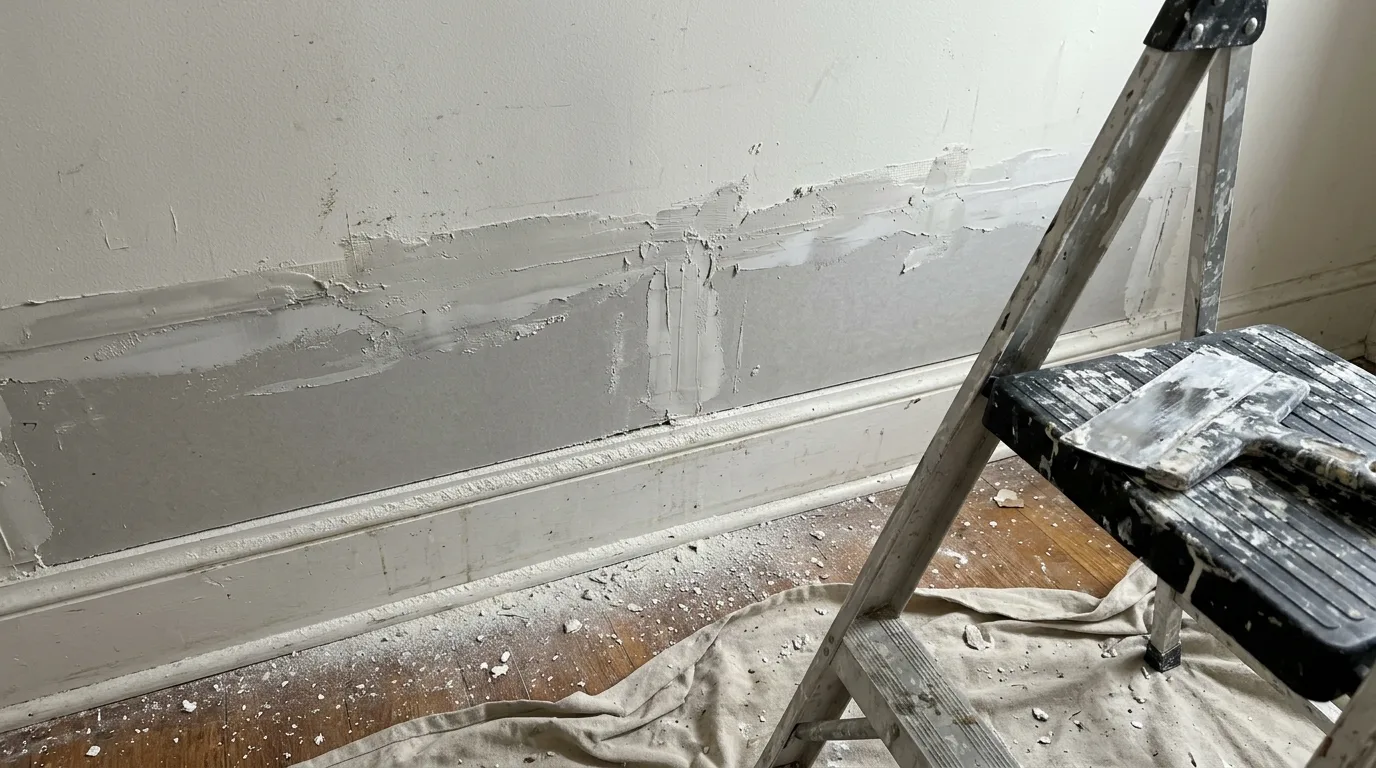
During drying, the crew may make a flood cut. That’s a straight cut across the wall above the highest wet reading. In the rebuild, a new strip of drywall goes in below that line. Then the seams are taped, mudded, sanded, textured and painted.
Per square foot, drywall is the cheapest material to restore. Matching the wall texture and paint takes more skill than hanging the board.
What does water damage repair include?
The rebuild covers whatever drying removed, plus anything the water ruined. A typical list looks like this:
- Drywall and insulation. New insulation goes into open walls before new drywall. The EPA says wet fiberglass and cellulose insulation should be thrown out and replaced (EPA, Table 1).
- Baseboards and trim. Baseboards are often pulled during drying so the wall behind can dry. Good ones go back on. Swollen baseboards made of MDF or particleboard usually get replaced.
- Cabinets. Toe kicks are often removed so air can reach under the cabinets. Swollen cabinet boxes, which are often particleboard, usually need new boxes or new cabinets.
- Flooring. Laminate, vinyl plank (LVP) and tile set over a wet subfloor often come up during drying. New flooring goes down once the subfloor tests dry.
- Subfloor and framing. Most subfloors dry. Plywood or OSB that stayed wet too long can swell, delaminate or rot. Rotted wood is structural damage, and it gets cut out and replaced.
- Paint and texture. Walls and ceilings are primed, textured to match and painted.
Ask for a written scope that lists each room and each item. Compare it with the drying company’s list of what was removed. The two lists should line up.
Ready to plan the rebuild? Call (425) 307-0286 and ask for a written repair estimate.
What should happen before the rebuild starts?
Rebuild should start only after the readings show the structure is dry. Closing up a wet wall traps moisture behind new drywall. That can lead to mold.
Check these before anyone hangs new drywall:
- Dry readings. Ask for the final moisture log. Every wet area should be back to its dry goal. Our drying time guide explains how dry is measured.
- No mold left behind. If mold showed up during drying, it has to be handled first. See mold remediation.
- A clearance check after sewage. After a sewage loss, ask how the area will be confirmed clean before walls go back up. See sewage cleanup.
Should older homes be tested for asbestos first?
Ask about it before old drywall, texture or flooring gets cut. The EPA lists textured paint, patching compounds used on walls and ceilings, and vinyl floor tiles among home products that may contain asbestos.
If you suspect a material has asbestos, the EPA says don’t touch it. A trained and accredited asbestos professional should take samples. Testing yourself isn’t recommended (EPA).
If the materials aren’t damaged and won’t be disturbed, the EPA says you don’t need to test. A rebuild usually disturbs them, so ask the company how it handles this in older homes.
Do water damage repairs need a permit?
Cosmetic work like painting, carpet, cabinets and trim doesn’t need a permit in Bellevue. Plumbing work, water heater replacement and remodeling that adds or replaces walls does (City of Bellevue, “When is a Permit Required?”).
After a leak, repairs usually follow these steps:
- No permit: painting, new carpet, new cabinets, baseboards and trim. Replacing a fixture on existing plumbing is also exempt.
- Permit needed: plumbing repairs, a new water heater, a new AC system, a new roof, foundation repair and electrical work beyond switches and plugs.
- Ask first: drywall replacement alone isn’t on the City’s list. The handout says the list isn’t complete. Ask Bellevue Building Inspections to confirm for your job.
The City gives two warnings worth repeating. Never use a contractor who says no permits or inspections are required. And if you pull the permit for a contractor, you become responsible for their work (City of Bellevue, “Tips on Contractor Selection”).
Bellevue requires contractors to register with the City before it issues them a permit (City of Bellevue, 2024). Ask for the registration number. For more on checking a company, see how we work.
How long does the rebuild take?
The timeline depends on how much was removed and how fast materials arrive. A patch and paint can be quick. Replacing cabinets or a whole floor takes longer, because those items often have to be ordered.
Other things that set the pace:
- Adjuster approval of the repair estimate.
- Permits and inspections, if the job needs them.
- Matching materials, especially discontinued flooring or custom cabinets.
- Mold or asbestos work, which has to be finished first.
Ask for a written schedule before work starts. Also ask who your one point of contact is, and whether there’s a final walkthrough. Get the answers in writing. Any warranty on the work should be in writing too.
The new flooring won’t match. Can I get all of it replaced?
Maybe. It depends on your policy wording and your adjuster’s decision.
Matching is a common problem. Flooring gets discontinued, and new boards can look different from older, worn ones. Some insurers pay to replace connected areas so the floor looks uniform. Others pay only for the damaged section.
These steps help you make your case:
- Ask the adjuster to explain the decision in writing, including the policy language it relies on.
- Get a written opinion from the flooring installer on why the new boards won’t match.
- Keep a leftover box or a sample of the original flooring if you have one.
- Take photos of the old and new boards side by side in daylight.
A restoration company can document the mismatch, but it can’t negotiate your claim.
Matching costs matter most where finishes cost more.
What happens to furniture and belongings during repairs?
Furniture usually moves to another room, the garage or off-site storage while floors and walls are rebuilt. Moving everything out and storing it is called a contents pack-out.
Not every company offers pack-out. Ask before work starts. If they do, ask for an inventory with photos of each item and its condition. That list helps if something goes missing or comes back damaged.
Keep stored items dry. Cabinets and wood furniture kept in a hot, humid garage can grow mold.
How much does water damage repair cost?
Repair is priced on its own estimate, after drying. Cabinets and flooring cost more.
The total depends on the rooms, the materials and how hard they are to match. See water damage restoration cost for price ranges and how estimates are built.
- No contractor may waive or absorb your deductible.
- Your adjuster decides what’s covered.
Toilet tank overflowed upstairs and water dripped out of a cabinet downstairs. What now?
Turn off the valve behind the toilet, then get a moisture check on the ceiling and walls below. Water that came out of a cabinet downstairs already passed through the floor and ceiling.
Water from a broken toilet tank is usually Category 1, or clean water, if there are no chemical additives. Water from an overflowing bowl with urine is Category 2 (IICRC S500, as summarized by NADCA). Either way, it soaked into the subfloor, the ceiling drywall and the insulation between the floors.
No stains yet doesn’t mean it’s dry. Stains don’t always show up right away. A moisture meter can find wet spots you can’t see. If the readings are high, drying comes first. Repairs come after.
- Shut off the toilet valve and wipe up what you can.
- Empty the cabinet below and leave its doors open.
- Take photos of the bathroom floor and the cabinet.
- Call (425) 307-0286 for a moisture check.
If a stain shows up on the ceiling below, see ceiling water damage.
Who does the rebuild?
You choose. The company that dried your home may also do the rebuild, or you can hire someone else. You can get a separate estimate for the repairs once the house is dry.
Using one company for both can mean fewer handoffs. Using a separate contractor lets you compare prices. Either way, check for City registration and a written scope.
A licensed plumber fixes any pipe or water heater. For who does the work and how to check them, see how we work.
Frequently asked questions
Do I need repairs, or was drying enough?
If anything was cut out or pulled up during drying, you need repairs. If everything dried in place, you may only need touch-up paint.
When should the rebuild start?
Only after the readings show the structure is dry. Closing up a wet wall traps moisture behind new drywall, which can lead to mold.
Does the adjuster need to see the damage before repairs?
Yes.
Do water damage repairs need a permit?
Cosmetic work like painting, carpet, cabinets and trim doesn’t. Plumbing work, water heater replacement and remodeling that adds or replaces walls does (City of Bellevue, “When is a Permit Required?”).
Can the new flooring be replaced to match?
The answer depends on your policy wording and your adjuster’s decision. Ask the adjuster to explain the decision in writing, and get a written opinion from the flooring installer on why the new boards won’t match.
How much does water damage repair cost?
Repair is priced on its own estimate, after drying. The total depends on the rooms, the materials and how hard they are to match. No contractor may waive or absorb your deductible.
House dry and ready for repairs? Call (425) 307-0286
Have your moisture log, photos and adjuster’s estimate handy. Then call.