
Bellevue, WA · King County
Slab Leak Water Damage
A slab leak is a leak in a water or drain pipe under your home’s concrete slab. You might notice a water bill that jumps, a warm spot on the floor or damp carpet with no clear source. A licensed plumber finds and fixes the pipe. A restoration company dries the floors and walls that got wet.
Not sure it’s a leak? Check your water meter first. The steps are below. If the dial keeps moving with every tap off and floors are wet, call (425) 307-0286.
What is a slab leak, and what causes it?
The leak under the slab is a leak in a pipe that runs under or inside a home’s concrete slab. It can be a pressurized water supply line or a drain line. Most this leak stay hidden until water shows up on the floor or on the water bill.
Several things can wear these pipes out:
- Newer homes often use PEX. Ask a plumber what yours are.
- Soil movement can put stress on pipes under a slab.
Cast iron drain pipe usually lasts about 35 to 50 years (Foundation Performance Association, 2005). Homes with original cast iron drain lines may be near or past that age.
What are the signs of a slab leak?
Common signs include a higher water bill with no change in use, and the sound of running water when everything is off. Fixr also lists warm or cold spots on the floor (Fixr, 2025).
Watch for these signs:
- A water bill that jumps for no clear reason.
- Running or hissing water when no tap, toilet or appliance is on.
- A warm spot on a tile or wood floor. A leaking hot water line can heat the slab above it.
- Damp carpet, swelling baseboards or cupping wood floors with no leak in sight.
- A musty smell in rooms built on the slab.
- New cracks in the floor or slab, or a raised spot in the floor.
- Lower water pressure across the house.
- Puddles or unusually green grass near the foundation.
Warning signs do not prove the leak under the slab. A running toilet or an irrigation leak can raise a water bill too. The meter test below helps you tell the difference.
How do I check my water meter for a hidden leak?
Turn off every tap and water appliance, then watch the meter. The EPA advises reading the meter before and after a two-hour period with no water use (EPA WaterSense). If the reading changes, you likely have a leak.
- Turn off all water use. That includes the ice maker, the washer, the dishwasher and the sprinklers.
- Find the meter box. In most Bellevue homes the City meter box is near the curb, between the sidewalk and the street (City of Bellevue). Lift the lid carefully. A meter box key or a large screwdriver helps.
- Look at the dial. Many meters have a small low-flow indicator that turns with even a little flow. Note the numbers too.
- Wait and check again. Check again after a few minutes for a quick look, or after two hours for the EPA test (EPA WaterSense). Any movement means water is going somewhere.
- Rule out the toilets. Put a few drops of food coloring in each toilet tank. If color shows up in the bowl within 10 minutes, that toilet leaks (EPA WaterSense).
- A drop in pressure points to a leak somewhere in the house (Roger Wakefield Plumbing Education, YouTube).
Dial still moving, and floors or walls are wet? Call a licensed plumber to find the leak. Then call (425) 307-0286 to reach a local restoration company that can check for moisture.
My water bill went way up, but a plumber found no leak. What’s going on?
Start with the cheap causes. A toilet that runs silently, an irrigation leak or a dripping hose bib can waste a lot of water. The EPA says a family of four using more than 12,000 gallons a month in winter could have serious leaks (EPA WaterSense).
If the meter still moves with all of those ruled out, the leak may be under the slab. Ask for a plumber who offers leak detection under the slab, not just a visual check. Keep a copy of your water bills, since they help date when the leak started.
How do plumbers find a leak under a slab?
Plumbers find this leak with pressure tests and listening gear before they open any floor. A good plumber pins down the spot first, so the slab is broken in one place, not several.
Common methods include:
- Pressure testing. The plumber isolates hot and cold lines and checks which one loses pressure.
- Acoustic listening. Microphones pick up the sound of water escaping under the concrete (Baker Brothers Plumbing, YouTube, 2016).
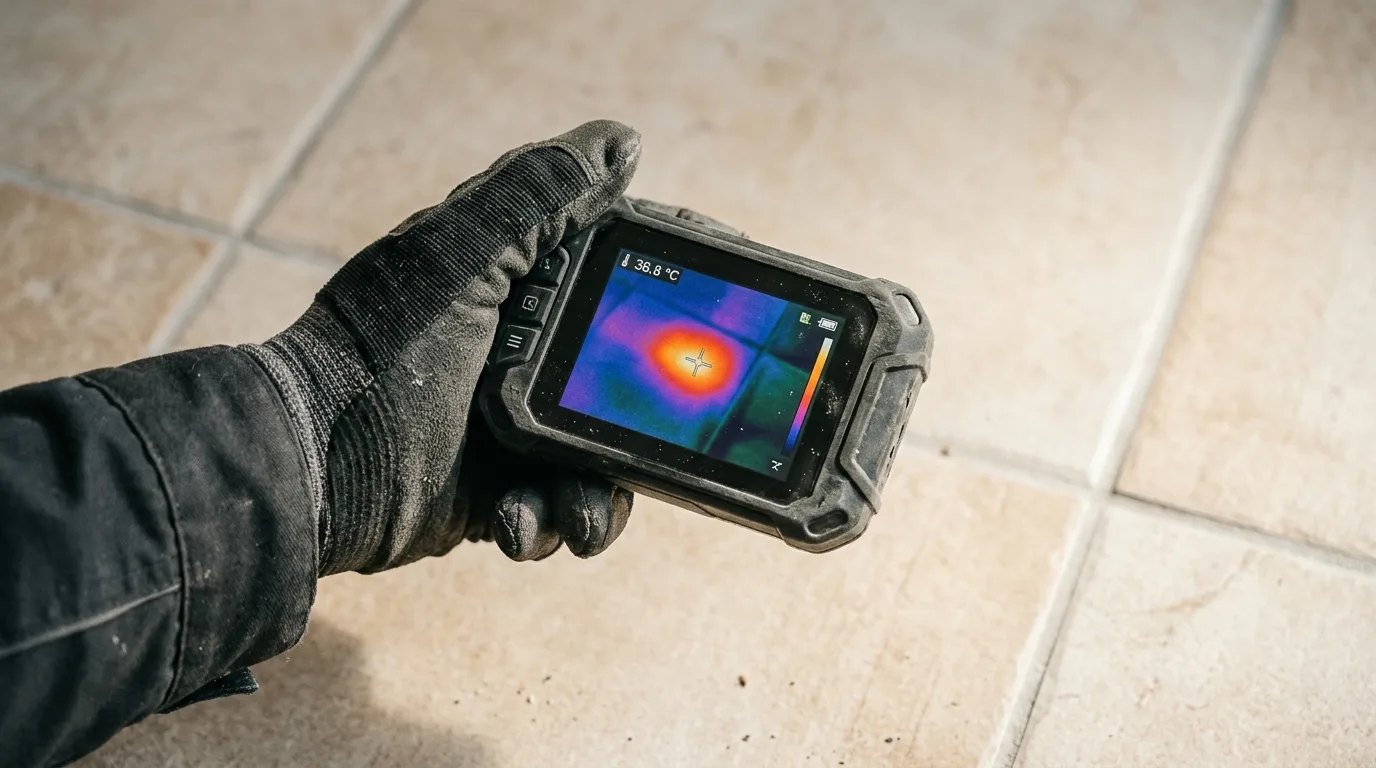
- A thermal camera. It can show a warm area over a leaking hot water line.
- A drain test or camera. For drain lines, the plumber may plug the line and fill it with water to see if the level drops.
A restoration company uses some of the same tools for a different job. It maps how far the water spread with moisture meters and a thermal camera. That tells it what needs drying, not where the pipe broke.
Who fixes a slab leak: a plumber or a carpenter?
Call a licensed plumber first.
The leak under the slab job usually splits like this:
- Plumber: finds the leak, repairs or reroutes the pipe and passes the City inspection. Ask for the Responsible Master Plumber’s license number.
- Restoration company: dries the slab, walls and floors, and documents the damage for your insurer.
- Flooring or rebuild contractor: replaces the flooring, baseboards or drywall that couldn’t be saved.
- Foundation engineer: needed only if the foundation moved. See the foundation section below.
What permit does a slab leak repair need?
Replacing a water or sewer line needs a permit in Bellevue (City of Bellevue, “When is a Permit Required?”). The licensed plumber normally pulls it. Contractors must also register with the City before working in Bellevue.
For under-slab line replacement, the City’s inspection checklist asks the plumber for three things (City of Bellevue Building Inspections, FM624RY062, 2025):
- Photos of all the work.
- A letter describing the work, signed and dated by the Responsible Master Plumber, with the master’s license number.
- A simple drawing of where and how the under-slab pipe was run.
Ask for copies of all three. They help with an insurance claim and when you sell the house.
What are the repair options: break the slab, tunnel or reroute?
The main ways to reach this leak are to break through the slab, tunnel under the house or reroute the line above the slab. Some pipes can also be lined from inside (Fixr, 2025). The plumber picks the method after finding the leak.
- Break through the slab (direct access). The plumber cuts the floor over the leak, repairs the pipe and patches the concrete. Flooring in that spot has to come up.
- Tunnel under the slab. The crew digs from outside and reaches the pipe from below. Floors inside stay intact.
- Reroute the line. The plumber leaves the old pipe in place and runs a new line through the attic or walls. Ask about it if the old pipes have leaked before.
- Pipe lining. A liner is placed inside the existing pipe. It works for some pipes, not all.
Ask the plumber why they chose a method, and get the price in writing first. Fixing one leak doesn’t stop the next old pipe from failing, so ask how old the rest of the lines are.
How much does slab leak repair cost?
The method changes the price a lot (Fixr, May 2025):
| Repair method | National cost range |
|---|---|
| Leak detection | |
| Breaking the slab for direct access | |
| Tunneling under the house | |
| Pipe lining | |
| Rerouting lines, usually through the attic |
A local plumber’s written estimate is the number to trust.
Drying and repairs are a separate bill. They depend on how far the water spread and what flooring you have. Our water damage restoration cost guide explains how drying is priced.
Can a slab leak damage my foundation?
It can. A leak changes soil moisture and can make the slab move, which can cause structural distress in the house above (El-Garhy and Wray, ASCE, 2006).
A leak adds water to one part of that soil and not the rest. Uneven swelling can push part of the slab up, which may crack floors, walls or door frames.
Not every crack means a leak, and not every leak moves a foundation. If you see new cracks after the leak under the slab, ask for a foundation engineer’s opinion before any foundation work.
Where does the water from a slab leak go?
Much of it may not soak in. So leak water may show up as damp floors, wet baseboards or soggy spots in the yard instead (Fixr, 2025).
Close the main shutoff right away and keep it closed except when you need water. Then get the leak fixed and the house checked for moisture.
How do I choose a foundation repair company?
Start with an independent engineer’s report, then get bids from companies that follow it. Ask each company who the engineer is and whether they’ll pull the permit.
We don’t rank or recommend foundation companies. A few things to check:
- That the company is registered with the City of Bellevue.
- That the bid matches the engineer’s pier plan.
- What the warranty covers, in writing, and whether it transfers when you sell.
Does homeowners insurance cover a slab leak?
Often the water damage is covered and the pipe repair isn’t. A leak that went on over time is generally excluded, and so is the mold it causes (Washington Office of the Insurance Commissioner).
This leak are hard because they are hidden. An insurer may argue the leak ran for months. That’s why the signs matter. It pointed to months of high water use and a warm spot the owner had ignored (Roger Wakefield Plumbing Education, YouTube, 2026).
Policies differ, so ask your agent these questions:
- Does my policy pay to reach the leak, such as breaking the slab or opening a wall?
- Does it pay for the pipe repair itself, or only the resulting water damage?
- Does it cover foundation damage caused by a plumbing leak? Is that an add-on (endorsement) I’d need to buy?
- Do I have water backup coverage for drain lines?
Does insurance pay for slab leak detection and repair?
Not always. Many policies pay for the water damage but not to fix the worn-out pipe that caused it. Cost guides warn that coverage varies, and that claims made after repairs are often denied (Fixr, 2025). So call your insurer before work starts, if you can.
Report the claim promptly, and keep the plumber’s written report. It should say what failed and, if possible, for how long.
Is a leak in the wall treated differently from one under the slab?
It can be. Coverage often turns on whether the leak was sudden or gradual, not on where the pipe is. A drip inside a wall that rotted the framing over months is usually treated as gradual (Washington Office of the Insurance Commissioner). A pipe that breaks suddenly under the slab may be covered as sudden. Your adjuster decides, based on the evidence.
My insurer won’t replace my hardwood floors. What can I do?
Ask for the reason in writing. Then compare its estimate with a written estimate from a flooring contractor.
A restoration company can document moisture readings and damage. It can’t argue your claim for you.
Leak found and floors wet? Call (425) 307-0286. Drying can start once the plumber has the water stopped or isolated.
What happens to my floors and walls after a slab leak?
The leak under the slab soaks the concrete from below, so floors over it stay wet longer than after a surface spill. Wet materials should dry within 24 to 48 hours to prevent mold (EPA). A restoration company sets up drying once the leak is stopped.
What gets saved depends on the floor:
- Carpet and pad. The pad usually comes out if it’s soaked. The carpet can sometimes be dried and relaid.
- Wood floors. Cupping wood may need to come up so the slab can dry. Sometimes it can be dried in place.
- Tile. Tile often stays, but water can sit in the slab underneath for a while.
- Baseboards and drywall. The bottom of the wall may be cut out if moisture wicked up.
The type of water matters too. A clean supply line is usually Category 1 water. A drain line leak is dirty water and may be Category 3, which needs cleaning, not just drying. See the water damage categories and classes, or our sewage cleanup page for drain leaks.
Concrete dries slowly, so slab jobs often take longer than the 3 to 5 days many homes need (ServiceMaster Restore water damage FAQ). Daily moisture readings, not the calendar, decide when the equipment comes off. Our guide to how long drying takes explains what slows it down. The first visit is covered on our extraction and drying page, and the rebuild on water damage repair.
Buying an older home? Test the plumbing first
Ask for a plumbing leak test before you buy, not just a visual inspection.
A water line test checks whether pressure holds with the meter valve closed. A drain test plugs the line and fills it with water. Ask whether the inspector or a plumber will do each test.
If a test finds a problem, who pays for it is usually something you negotiate before closing. Our guide to who pays for water damage covers inspection findings, rentals and condos.
Frequently asked questions
How do I know if I have a slab leak?
Check your water meter with every tap and water appliance off. If the dial moves, you likely have a leak. A jumping water bill, a warm spot on the floor, or damp carpet with no clear source are also signs.
Who fixes a slab leak?
A licensed plumber finds and fixes the pipe. A restoration company dries the floors and walls that got wet. Ask the plumber for the Responsible Master Plumber’s license number.
How much does slab leak repair cost?
Does homeowners insurance cover a slab leak?
Often the water damage is covered and the pipe repair isn’t. A leak that went on over time is generally excluded.
Do I need a permit for a slab leak repair?
Replacing a water or sewer line needs a permit in Bellevue. The licensed plumber normally pulls it. Contractors must register with the City before working in Bellevue.
Should I shut off the main if I suspect a slab leak?
Yes, if the dial keeps moving or floors are wet. Close the main shutoff right away and keep it closed except when you need water. Then call a licensed plumber, and call (425) 307-0286 for drying.
Slab leak? Call (425) 307-0286
Check the meter. If the dial moves, close the main shutoff and call a licensed plumber. If floors, baseboards or walls are wet, call (425) 307-0286. See all the areas we serve.