
Bellevue, WA · King County
Mold Remediation
Found mold after a leak? A small patch you can often clean yourself. The water problem behind it has to be fixed first, or the mold comes back.
Call (425) 307-0286.
What is mold after a leak?
Mold is fungus that grows on materials that stay wet. After a water leak, it can start within 24 to 48 hours on materials that stay wet (FEMA).
Mold can hide inside walls, under flooring and above ceilings, so the water problem has to be fixed before the mold work can last.
Do I need professional mold remediation?
Not always. If the moldy area is under about 10 square feet, you can usually clean it yourself. That’s roughly a 3-by-3-foot patch (EPA, “Mold Cleanup in Your Home”).
Owners working on their own home have an exemption, but that doesn’t make a big job safe to do alone.
Call a professional when:
- Large or repeating. The mold covers more than about 10 square feet, or keeps coming back.
- Dirty water. The mold followed sewage or floodwater, which is dirty water (Category 3).
- Hidden mold. You smell mold but can’t see it, which often means it’s inside a wall, floor or ceiling.
- HVAC or ducts. You think the mold is in your AC system or ducts.
- Sensitive people. Someone in the home has asthma, allergies or a weak immune system.
Not sure yet? Read the sections below first. If the musty smell won’t go away, call (425) 307-0286 and ask to be connected with a company that can check for moisture.
How fast does mold grow after water damage?
Mold can start within 24 to 48 hours on materials that stay wet (FEMA). Dry wet materials within 24 to 48 hours of a leak, and in most cases mold won’t grow (EPA, “A Brief Guide to Mold, Moisture and Your Home”).
Opening windows in July rarely dries a wet wall. Closed-house drying with dehumidifiers works better.
Drying fast is the cheapest mold prevention there is. Our extraction and drying page explains how a house gets dried and checked. Our guide to how long drying takes covers the timeline.
Could mold grow while I wait for help? It can, if things stay wet for days. Remove soaked rugs and cushions from the wet area. Run your own fans and a dehumidifier if you have them, and keep the AC running if it isn’t the source of the leak and you don’t suspect mold in it.
I still smell mustiness after the water was removed. Was it dried wrong?
Maybe. The EPA says a cleanup isn’t finished while visible mold or moldy odors remain. A lingering smell often means wet material was left behind, such as pad, insulation or the bottom of a wall. Ask for moisture readings in the area before anything gets painted or rebuilt.
Can I clean up mold myself?
For a small area, yes. Fix the water source first, then clean, then dry. Our checklist for what to do right after water damage covers the first steps. The EPA gives a few rules worth following:
- Don’t paint over mold. Paint over moldy surfaces is likely to peel (EPA).
- Throw out porous materials. Throw out moldy porous materials if they can’t be cleaned. The EPA says ceiling tiles and carpet may have to be discarded.
- Don’t run the HVAC. Don’t run the HVAC system if you know or suspect it’s contaminated with mold. It can spread mold through the house (EPA).
- Protect yourself. Wear gloves, eye protection and a well-fitted N-95 respirator while you clean (EPA mold cleanup guide for homeowners).
Should I replace moldy drywall or clean it?
Replace it. Drywall is porous, so mold grows into the paper and gypsum, not just on the surface. Cut out the moldy section and some clean material around it, and let the wall cavity dry before closing it up. Hard surfaces like tile, metal and sealed wood can usually be cleaned instead.
If the mold area is bigger than you’re comfortable with, stop and call (425) 307-0286.
Who tests for mold and who removes it in Washington?
Washington has no state certification for mold testing or removal (Washington State Department of Health). Ask each company for its training, insurance and references.
A mold job usually splits into three roles:
- Mold assessor: inspects, takes samples if needed and writes the remediation plan (protocol).
- Mold remediation company: removes the mold by following that plan.
- Assessor again: comes back after the work for a clearance check, often called post-remediation testing.
Keep it.
Be careful with any company that offers “free mold inspection” and removal as a package.
What happens during mold remediation?
The remediation company follows the assessor’s plan. The current industry standard for this work is ANSI/IICRC S520, now in its 2024 fourth edition (IICRC). A typical job looks like this:
- Stop the moisture. The leak gets fixed and the area gets dried first. Mold removed from a wet wall grows back.
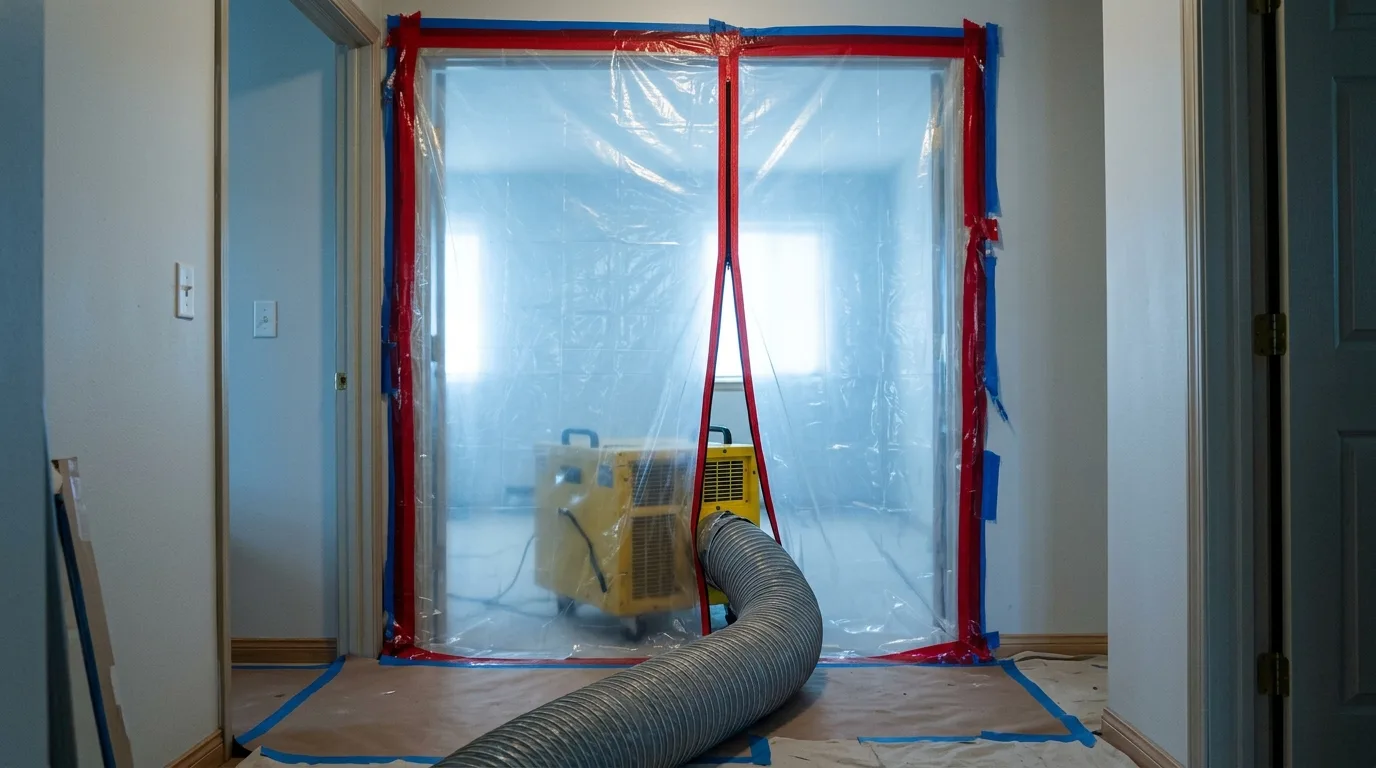
- Set up containment. Plastic sheeting (a poly barrier) seals the work area from the rest of the house.
- Run negative air. HEPA air scrubbers filter the air and keep spores from drifting into clean rooms.
- Remove what can’t be cleaned. Moldy drywall, insulation, carpet and pad are bagged and taken out.
- Clean what stays. Framing and hard surfaces are HEPA-vacuumed and cleaned. Some plans also call for an antimicrobial treatment.
- Clearance. The independent assessor checks the area before containment comes down and rebuild starts.
Odor removal usually happens as part of the cleaning. If the smell remains after clearance, ask why.
How much does mold remediation cost?
The price depends on how much material comes out, how hard the area is to reach, and how many days containment and air scrubbers run.
The assessment is a separate bill, since a separate company does it. Rebuild work, like new drywall and paint, is often priced separately too. Ask for a written estimate that lists each part. Our water damage restoration cost guide shows how invoices are built.
Does homeowners insurance cover mold in Washington?
Sometimes. Mold from a slow leak that went on for weeks usually isn’t.
Look in your policy for a mold limit, exclusion or endorsement.
A few practical points:
- Report quickly. Report the water damage quickly. Waiting can turn a covered leak into a “gradual” one.
- Photograph first. Take dated photos of the leak and the mold before anything is removed.
- Your adjuster decides. Your adjuster decides what’s covered.
- Claim history. Mold and water claims show up in insurance claim databases.
What should Washington tenants know about mold?
Tell your landlord in writing as soon as you see mold or a leak.
Renters insurance usually covers your belongings, not the building. Who pays for what in a rental is covered in our guide to who pays for water damage.
Frequently asked questions
Can I clean up a small mold patch myself?
For a small area, yes. If the moldy area is under about 10 square feet, roughly a 3-by-3-foot patch, you can usually clean it yourself (EPA). Fix the water source first, then clean, then dry.
Call a professional sooner if the mold followed sewage or floodwater, or if you think it’s in the HVAC system.
How fast does mold grow after water damage?
Mold can start within 24 to 48 hours on materials that stay wet (FEMA). Drying wet materials within that window means in most cases mold won’t grow (EPA).
Does homeowners insurance cover mold?
Sometimes. Mold from a slow leak that went on for weeks usually isn’t.
Can the same company test for mold and remove it?
No.
Mold after a leak? Call (425) 307-0286
Fix the water first, then deal with the mold.